

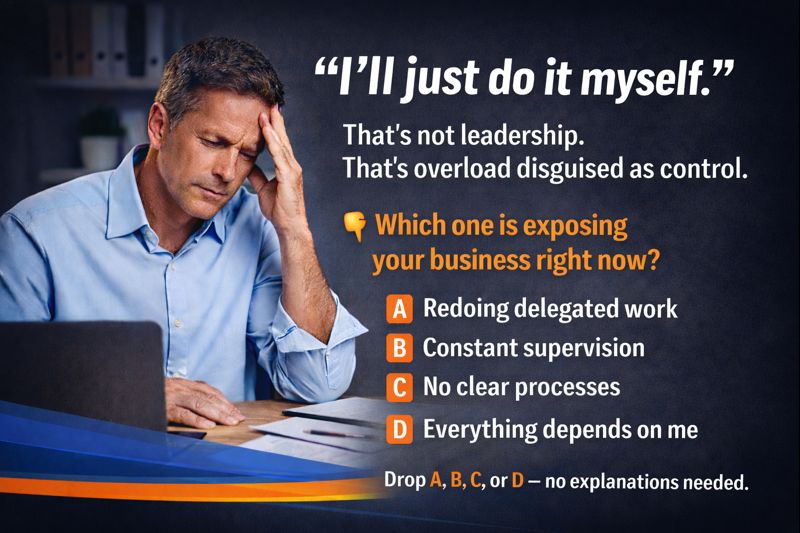
Delegation challenges in business often begin with a quiet thought many leaders don’t say out loud:
“I’ll just do it myself.”
Not because the team is lazy.
Not because people are incompetent.
But because delegation feels risky when expectations are unclear.
You assign a task.
It comes back half-done.
You correct it.
You redo it.
After a while, it feels faster to stop delegating altogether.
This is one of the most common delegation challenges in business today — and one of the most exhausting.
Common Delegation Challenges in Business
As organizations grow, delegation should become easier. In reality, the opposite often happens.
Research has consistently shown that unclear roles and poor delegation negatively impact performance, as highlighted by leadership studies from Harvard Business Review.
Some of the most frequent delegation challenges in business include:
- Unclear job roles
- Lack of documented processes
- Team members needing constant supervision
- Leaders holding too much operational knowledge
When these issues exist, delegation doesn’t feel like support — it feels like extra work.
Over time, leaders become bottlenecks.
Teams become dependent.
And growth starts to feel heavy instead of exciting.
Why Delegation Challenges in Business Exhaust Leaders
Delegation challenges in business rarely show up as one big problem. They show up quietly:
- Long workdays
- Constant follow-ups
- Repeating the same instructions
- Feeling like nothing moves unless you’re involved
This is how capable leaders burn out — not from lack of effort, but from lack of structure.
The issue is rarely people. It’s usually the absence of systems that allow people to perform confidently without constant oversight.
When roles are unclear and processes live only in someone’s head, delegation will always feel frustrating.
How Structure Reduces Delegation Challenges in Business
The most effective way to reduce delegation challenges in business is not stricter control — it’s clarity.
Clear structure creates:
- Defined responsibilities
- Standard ways of working
- Consistent expectations
- Confident teams
When people know what is expected and how to deliver it, delegation becomes a relief instead of a risk.
Delegation Is Not the Problem — Systems Are
Many leaders assume delegation problems mean they hired the wrong people.
Often, that’s not true.
More commonly, delegation challenges in business signal that:
- Growth has outpaced structure
- Leadership skills haven’t evolved with scale
- People systems need to be reviewed
The real question isn’t who is failing —it’s what system is missing.
Let’s Hear From You
Every organization faces delegation challenges in business at some point.
Which one feels most familiar right now?
- Delegating without redoing the work
- Managing people who need constant supervision
- Lack of clear roles and processes
- Training takes too much time
Share your thoughts in the comments.
You’re not alone — and your experience might help someone else reading this.

